
The immune system of a newly hatched chick is only partially mature. Consequently, the chick cannot provide full protection against pathogens when it first encounters the external environment after hatching (Fred Davison et al., 2008). Brooding conditions during this critical stage strongly influence the development and effectiveness of the immune system. Underestimating weaning conditions is a very serious mistake, optimal conditions are essential.
How the Immune System Develops
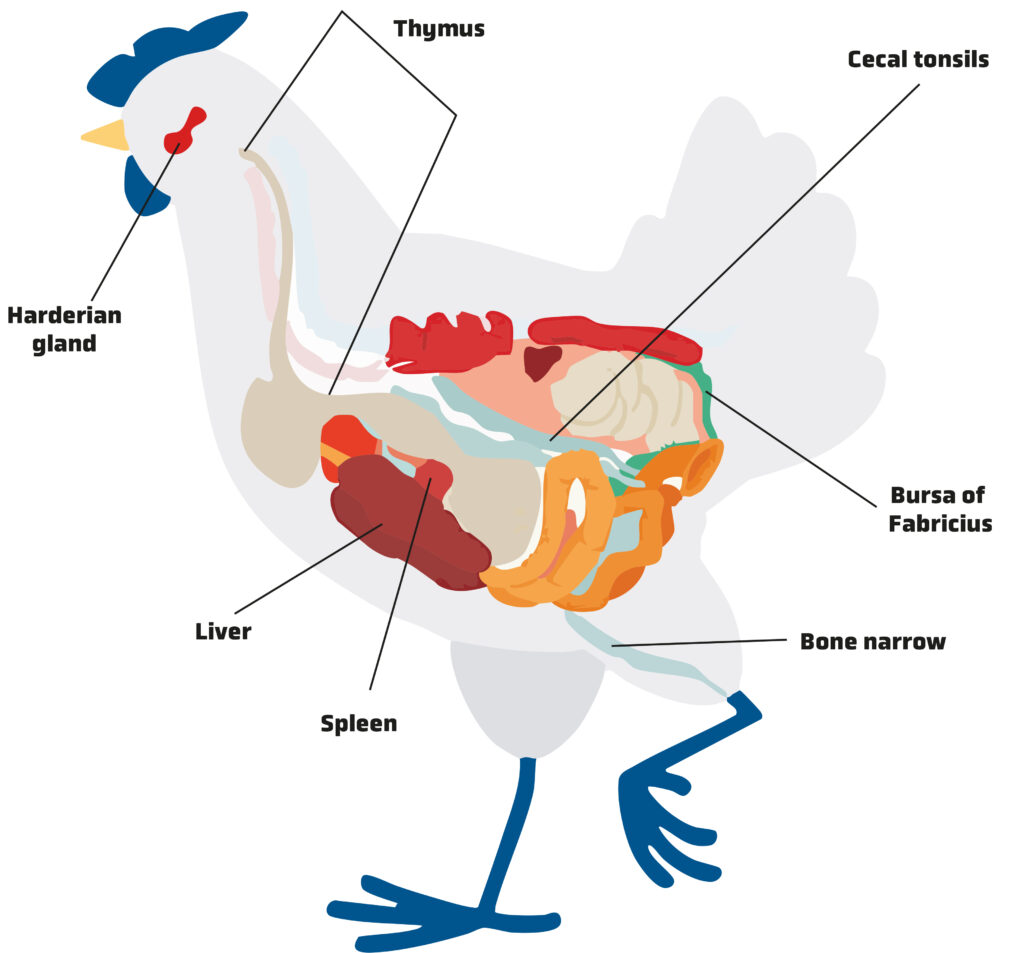
The immune system consists of primary organs (already functional at hatch) and secondary organs, which continue to mature during the first weeks of life:
- Bursa of Fabricius & Thymus: Fully functional before hatch.
- Spleen: Reaches peak lymphocyte activity around 4–5 weeks (Paulpierre et al., 1998).
- Harderian Gland: Plasma cells increase rapidly between 2–4 weeks (Bang & Bang, 1968).
- Gut-Associated Lymphoid Tissue: T-cell populations stabilize at 4–5 weeks.
- Pineal Gland: Peak immune activity at 32 days (Maestroni et al., 1988).
- Peyer’s Patches: Appear shortly after hatch, reaching full development in 6 weeks.
- Cecal Tonsils: Detectable in 10 days (Albini & Wick, 1974).
This timeline highlights the importance of the brooding period: immune maturity depends on careful management during the first critical weeks.
Factors Affecting Immune System Development in the First Weeks
Pre-Arrival Preparations
- Cleaning and Disinfection: Proper cleaning should remove at least 80% of microbes. Disinfection, an essential step, drastically reduces sanitary pressure. Good practice would be to verify the conditions by taking swabs and sending them to the laboratory, on the various surfaces of the farm in order to ensure good washing and disinfection practices.
House Pre-Heating
- Pre-heat the poultry house 24 hours before chick arrival in summer, or 24–48 hours before in winter.
- Litter temperature must be at least 30 °C (86 °F) at chick level to prevent huddling, poor feed and water intake, and subsequent stress.
- Make sure the litter is of good quality and avoid dusty litter.
Good brooding conditions ensure timely immune system development. A robust immune system enables pullets respond better to vaccinations and resist disease challenges.
Five Pillars of Poultry Health Management
- Biosecurity
o Wash hands before and after handling birds or equipment.
o Restrict access, use footbaths, and control wild birds and rodents.
o Quarantine new flocks and separate age groups.
o Isolate sick birds promptly to reduce spread of disease
o No visits from outsiders unless strictly necessary, including the owners!
o All waste produced during the day must be quickly disposed of from the farm in designated disposal areas. - Vaccination
o Implement programs tailored to local disease risks.
o Include deworming every 3–6 months when necessary.
o Ensure proper storage and record keeping of veterinary products, in compliance with suppliers’ instructions. - Environment
o Maintain optimal temperature, humidity, and ventilation.
o Manage lighting according to breed guidelines.
o Apply strict litter and waste management practices.
o Have a meticulous daily recording system. - Nutrition
o Provide a balanced diet according to breed guidelines.
o Guarantee clean, continuous water supply (test annually).
o Daily water disinfection treatments are recommended, as well as regular flushing of the drinking system to remove any mineral and bacterial deposits. - Health Monitoring
o Monitor daily for signs of illness: reduced appetite, drooping wings, diarrhea, coughing, or sudden drops in egg production.
o Growth during the rearing phase in line with breed standards is the main indicator of good health conditions of the animals.
o Observing feathering throughout all growth stages, taking into account natural moults with age, is another important way to assess the health of pullets and laying hens, especially in systems other than battery cages.
o Conduct regular veterinary checkups and adjust vaccination programs as needed.
o Keep detailed records of feed, water intake, vaccinations, and mortality.
o Mortality monitoring must be performed daily. Carcasses should be disposed of in special containers compliant with local veterinary and legal requirements. Promptly record them in the company records; it is good practice to add notes to the records so that the evolution and type of mortality can be remembered even after a long time.
o For free-range flocks, rotate pastures to prevent parasite buildup and provide shade and predator protection.

Conclusion
By ensuring proper brooding, applying strict biosecurity, and following best practices in nutrition, vaccination, and health monitoring, poultry producers can help chicks develop a strong immune system from the start. This foundation not only reduces disease risk but also improves flock performance, welfare, and long-term sustainability. Daily observation remains the cornerstone of success: early recognition of problems allows for rapid corrective action. Knowledge of poultry behavior, collaboration with veterinarians, and staying updated on disease alerts are indispensable tools for modern poultry health management.