

The hatch window or hatch spread is an important tool to monitor the hatchery process. Implementation of a random control of hatch windows is mandatory when you are in continuous improvement and to ensure chick welfare.
The hatch window can be defined as the time span between the first chicks hatched and the last chick hatched in a hatcher with an ideal environment. Hatch windows can be monitored and can provide useful
information for managing the entire hatchery process.
The duration of the hatch window depends on two key factors:
- All embryos set are at an identical stage of their development at the beginning of incubation.
- All embryos in the setter are equally developed (uniformity of conditions)
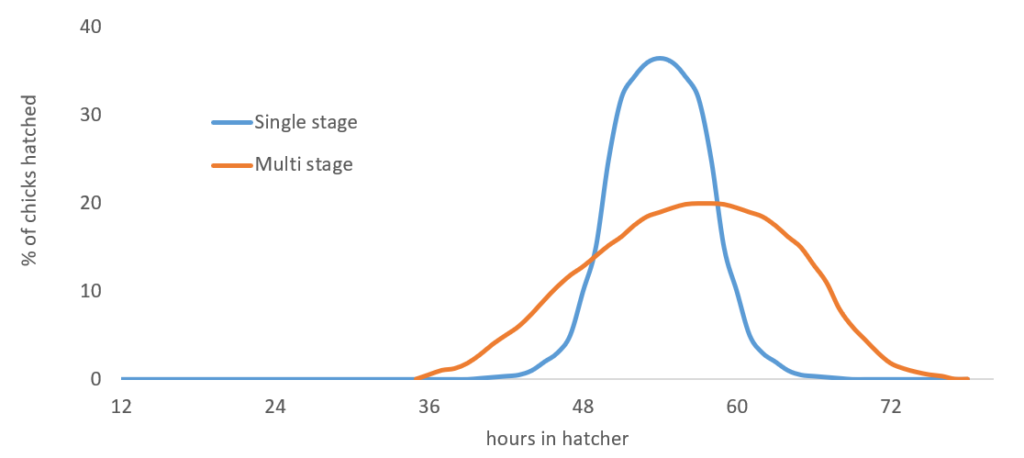
The graph below is an example of a hatch window; a chick hatching too early can face difficulties in rearing due to advanced levels of dehydration.
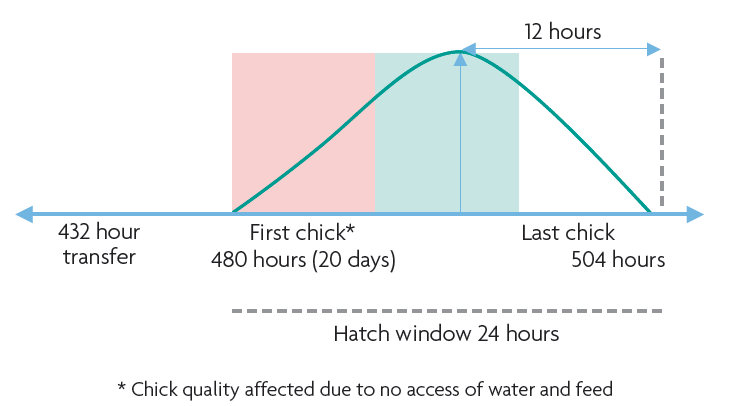
Monitoring of hatch windows (HW) can be performed 36, 24 and 12 hours before pulling time to get a full view of the whole hatchery process. By monitoring hatch windows, the hatchery manager can secure the quality of chicks by adjusting the hatcher parameters (Temperature, humidity and CO2 adjustments).
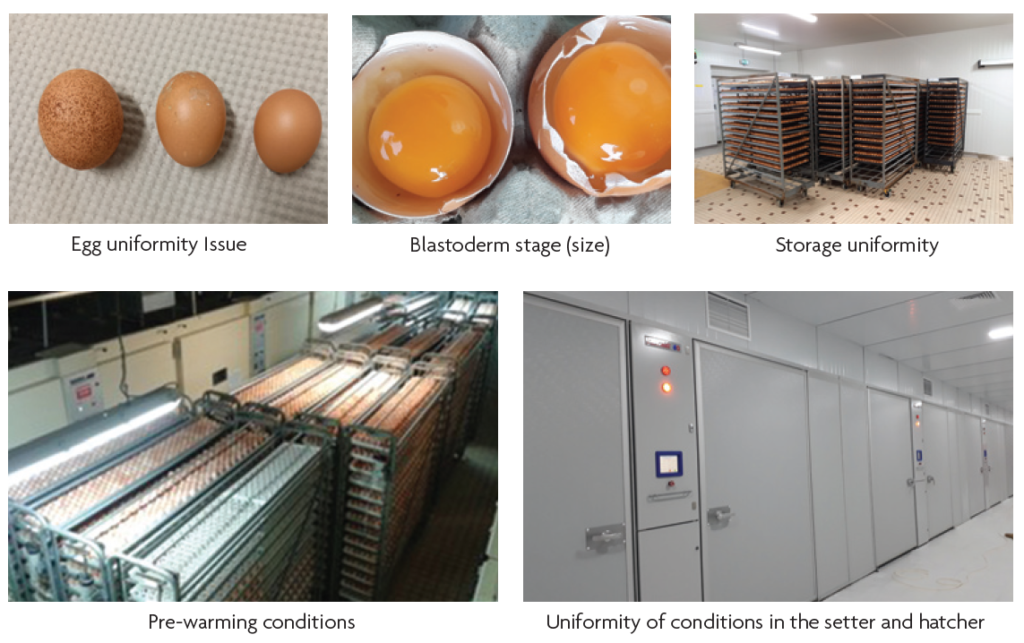
Chicks will not hatch at the same time mainly due to variation in embryonic development. In addition, eggs incubated in the same setter will not have faced the same conditions prior to incubation. Different factors like flock age, egg size, egg farm management, storage times and uniformity of environmental conditions will affect incubation duration.
Incubation duration is mainly affected by the rate of embryonic development and the temperature experienced by the embryo during incubation.
Managing equal egg temperature from oviposition to egg setting is not an easy task and requires proper equipment limiting any fluctuation. Uniformity of temperature conditions meaning adequate temperature distribution is crucial to achieving short hatch windows. Conditions prior to setting, if non-uniform, will definitely affect hatch windows.
Uniform conditions in the setter/hatcher meaning the equipment design, operation and profile are key parameters for achieving a narrow hatch window. Short hatch windows can only be achieved if the interaction between the setter/hatcher and the embryo is well managed.
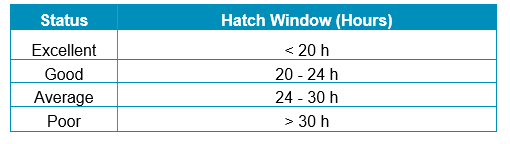
If conditions are properly managed prior to egg setting, meaning from farm to hatchery storage and with single stage management with a good profile, it is possible to get short hatch windows of less than 20 hours.
With hatch windows longer than 24 hours, day old chicks hatched first will face dehydration and they will be more prone to issues during the rearing period. The reduction in chick uniformity will be greater with wide hatch windows and first week mortality will be higher. It is often observed that chicks coming from wide hatch windows face difficulties starting in the rearing farm and mortality can occur after 3 or 4 days.
HATCH WINDOWS ASSESSMENT
Hatch window investigation consists in counting the number of chicks hatched in the hatcher after egg transfer. It is important to establish the chronology of the hatch and this information is useful, it will guide the hatchery management team in fine-tuning the process.
When involved in continuous improvement of the hatchery process it is important to monitor the hatch windows at different times prior to chick pulling or at different times after egg transfer. After transfer, eggs can be checked to determine when the first chick hatched
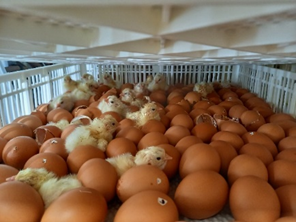
The procedure is quite simple and will be described below:
- Select three trays of hatching eggs after transfer at different roller levels (top/middle and bottom): A, B and C
- Frequency of checking can be 38, 23 and 13 hours before chick pulling (CP)
- Count the chicks in the basket for trays A, B and C and record the data
- Put the trays back in the hatcher
Targeted results:
- 38 hours before chick pulling: no chicks in the basket
- 23 hours before chick pulling: around 20% of chicks in the basket
- 13 hours before chick pulling: 80% of chicks in the basket
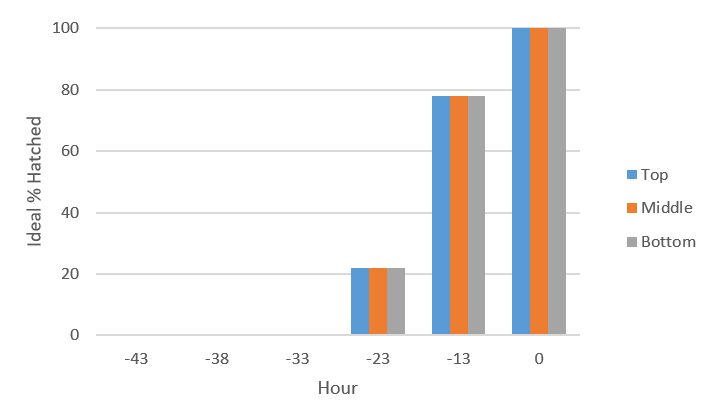
pulling.
In the event of higher percentages, and considering the age of the flock of origin, the management team will modify either the egg setting time or the pulling time.
Day old chick quality can easily be affected if the hatchery operator in charge of the hatching day does not properly monitor evolution in the number of chicks in the basket over time. Uniformity of eggs and conditions surrounding eggs are a key point in achieving a narrow hatch window.
POSITIVE EFFECT OF EARLY FEEDING
Feeding day old chicks as soon as possible after hatching is a factor that will positively affect the development of the intestinal tract. Also early feed intake will contribute to a better absorption of the residual yolk sac. It has been shown that it will have a positive impact on the survival rate of the chick at the beginning of the rearing period mainly due the absorption of the immunoglobulins stored in the yolk. Additionally, early feeding has a positive effect on Bursa of Fabricius development.
Conversely, delaying access to water and food will affect the average daily gain (ADG) during the rearing period. A day old chick’s performance will be affected, with body weight below the standard and a higher mortality rate.
FACTORS AFFECTING THE HATCH WINDOW
- Egg collection frequency
- If eggs are not collect at the right time, different sizes of blastoderm will affect the HW
- Egg Uniformity
- Lack of uniformity will affect air flow in the setter and HW will be wider
- Egg quality
- Egg quality will affect the HW
- Setter and hatcher uniformity (temperature/humidity/air flow)
- Without uniformity in setters and hatchers it is difficult to achieve a narrow HW
- Loading patterns
- Incorrect egg loading will not secure the air flow surrounding the hatching egg and therefore will affect the HW
- Transfer patterns
- Transferring eggs from a setter’s cooler areas to the warmer areas in the hatcher will help reduce the Hatch window
- Incubation management: single stage/multi-stage
- The hatch window fluctuates according to hatchery management; with multi-stage management, the HW is wider due to numerous temperature fluctuations.
RULES OF THUMB TO ACHIEVE A NARROW HATCH WINDOW:
- Egg uniformity is essential in terms of size but also uniformity of conditions faced
- Uniformity of environmental conditions between egg collection and egg setting is mandatory to achieve a narrow hatch window (farm management)
- Pre-warming conditions prior to egg setting play an important role in achieving a narrow hatch window.
- Pre-warming the hatching egg at 25°C in a setter will provide more uniformity compared with egg pre-warming in the incubation room for 10 or 12 hours
- Equipment with high heating capacity should allow the hatching egg to achieve the onset of incubation within 6 to 8 hours according to egg mass.
- Well sealed setters with uniform temperature distribution will ensure achievement of a narrow hatch window.
CONCLUSION
Many factors influence the hatch window. Uniformity of eggshell temperature during incubation is the most important factor affecting the hatch window. Uniformity is linked with the design of the setter, the profile and hatchery operation. A short hatch window duration is a target to achieve in all hatcheries but is not achievable without good equipment and without proper hatching egg management.
In terms of chick welfare, the hatch window must be monitored closely to avoid chick quality reduction and to ensure chick weight uniformity. Regularly checking the chick conditions in the hatcher and changing the setpoint to secure chick welfare is essential to maintain optimal chick quality until delivery to the farm.
Published in International Hatchery Pratice – Volume 35 Number 7
