
Egg storage is defined as the time between oviposition and setting of the egg (incubation). Managing the hatching egg during this storage period correctly is a critical point in farms and hatcheries.
Cell development in an egg starts already in the infundibulum (funnel) after fertilisation. At the time of oviposition, the blastoderm (germinal disc) is already composed of approximately 40,000 to 60,000 cells.

The chance to get a chick from this Blastoderm is according to the storage management
The blastoderm viability will be affected by the storage time, conditions which as a result can negatively affect hatchability and chick quality. This negative effect can be explained by the alteration of the composition of the egg. Internal egg composition is changing during storage: the albumen becomes thinner (measured by albumen height); the yolk membrane strength decreases and the pH is increasing mainly due to C02 exchange. All these changes are affecting the percentage of hatchability and chick quality.

It is recommended to store hatching eggs not any longer than one week. Special management techniques have to be implemented in case the storage time needs to be longer. This includes all actions to slow down the alteration of the internal components of the egg. Every hatchery should be aware and prepared to be able to apply these specific measures. The main actions points to obtain good hatchability and chick quality are mentioned hereafter.
Egg storage time

Hatchability will naturally decrease with storage time due to changes of the propriety of the yolk and albumen. PH will definitely increase according to surrounding conditions, also affecting albumen density, which is linked to nutrient transportation to the embryo.

As we can see above, the storage length affects the egg composition which has a direct impact on hatchability and chick quality. The priority is to minimise the negative effect of the storage time on egg composition. Implementation of proper procedures is necessary to limit the reduction in hatchability.
Egg temperature
Within 6h after oviposition the egg needs to be cooled down in a uniform and gradual way; be aware that too fast cooling down can weaken the blastoderm.
The temperature during storage needs to be lower than “physiological zero”, meaning 25-26°C, and needs to be adjusted according to the days of storage foreseen.
Avoid direct air flow on the eggs and target for a minimum relative humidity of 75% to minimize air chamber development. Minimizing temperature fluctuations will improve the embryonic liveability
as temperature uniformity plays an important role. Therefore avoid irregular cooling.
Egg position
This is also playing an important role to maintain hatchability and chick quality:
- turning the eggs during storage will improve embryo viability and chick quality
- position the eggs with the small end up to limit the reduction of hatchability in case of longer storage time.

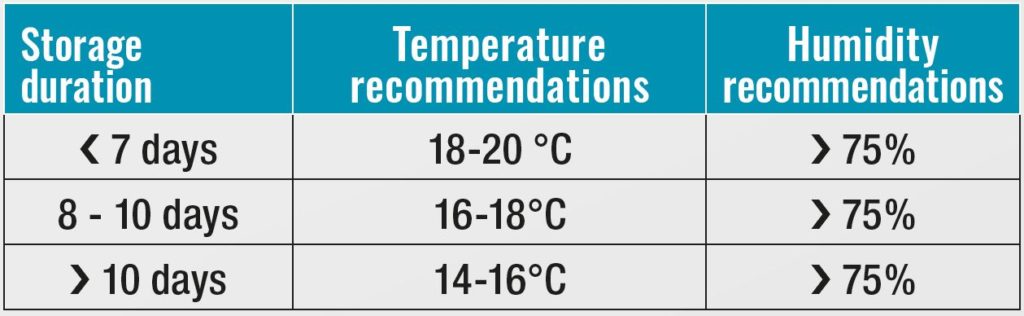
A general rule is that when storage time increases, storage temperatures decrease.


For a storage time longer than 10 days, store the egg with the small end up will positively affect the blastoderm viability (Mayes and Takeballi, 1984). It is easier to implement with a small number of eggs, but this technique limits the alteration of the components of the egg (Hatchability improvement by at least 2%).
SPIDES
SPIDES (Short Period of Incubation During Egg Storage) is the most effective way to preserve the embryo viability. With the heat treatment applied to the egg, the blastoderm reaches a more stable stage for long storage (Fasenko et al; Lourens 2006). The SPIDES principle is based on a short heat treatment to promote
cell development. To be efficient the egg shell temperature should reach 32 °C and no more than a total of 12h in three treatments should be applied. This technique is only effective if the eggs are properly cooled down after oviposition.
The first heat treatment has to be applied at least before 5 days, the second and third treatment should be applied at 10 and 15 days respectively. Even a single heat treatment has a positive impact on the hatchability.
Nowadays many hatchery equipment suppliers are proposing solutions to apply this technique in practice. But even if a hatchery is equipped with this technology the egg storage conditions have to be ideal as described above.
Egg storage summary
- Incorrect storage conditions can have a tremendous negative effect on hatchability and chick quality.
- Securing storage conditions is the key to limit the reduction in hatchability. ➔ The decline in hatchability is proportional to the length of storage and storage conditions. Special attention has to be considered on stability and uniformity of conditions (temperature and humidity) during storage.
- Improper storage will affect early embryonic mortality and temperature homogeneity will be affected which will have a negative impact on the hatch window and chick quality.
- Storing eggs in optimal conditions in a wellisolated room with evenness of temperature and humidity will secure embryo viability and performance of the hatchery.
- All actions to prevent the negative impact of storage time have to be implemented: egg turning as from the beginning for short storage; eggs stored with the small end up or egg heat treatment for long storage.

