
Egg weight is a key criterion in table egg production. It directly determines the commercial egg size and reflects market expectations, which can vary significantly from one market to another. At the beginning of laying, eggs are smaller and their weight gradually increases as hens age. Egg weight tends to stabilize around peak of production, before continuing to increase gradually towards the end of the production cycle. The aim of selection is to control this trajectory, to respond to specific market expectations while preserving other essential traits related to performance, egg quality, health and the resilience of the laying hens.
What influences egg weight?
Egg weight is a multifactorial trait influenced by the age of the hen. The first eggs are relatively small, and their weight gradually increases with age, mainly due to increases in yolk and albumen weight.
The body weight of the pullet at the onset of lay also plays an important role in the weight of the first eggs and in how egg weight evolves throughout the cycle. Pullets that are too light will start laying later and produce smaller eggs. Nutrition, environment and flock management are also factors that influence this trait.
Beyond these factors, egg weight has a strong genetic component, which accounts for nearly 50% of the observed variation!
Selecting a trajectory rather than simply a weight
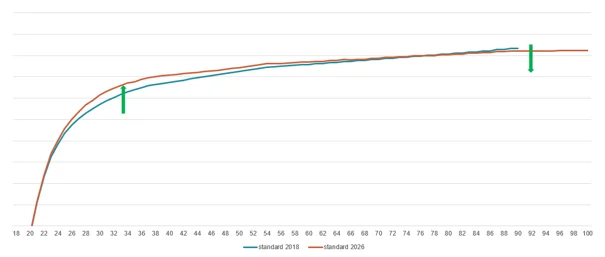
In Novogen breeding programs, egg weight is measured individually on a large number of birds and at different ages. These data allow us to monitor how egg weight evolves in each hen throughout the cycle and to identify birds that display the desired characteristics. Selection aims to shape the egg weight curve in order to produce the right weight, at the right time
This approach can be summarized into two key objectives:
- At the beginning of lay: reaching the target weight quickly
The objective is to promote a rapid increase in egg weight in order to meet market expectations earlier and maximize the value of production from the very beginning of lay.
- Towards the end of lay: limiting the increase in egg weight
Towards the end of the laying cycle, the objective is to limit the increase in egg weight in order to remain within a weight range suited to market expectations, which generally favor standard-sized eggs. Controlling this evolution also helps to preserve egg quality, particularly shell quality. As hens age, egg weight continues to increase while shell weight tends to stabilize. As a result, the shell accounts for a smaller proportion of the total egg weight and becomes thinner and more fragile.
Maintaining a more stable egg weight towards the end of the cycle also helps improve laying persistency and production consistency.
Results built over time
Selection delivers progress generation after generation. Therefore, progress is not only measured by the average weight of an egg, but also by the way this weight evolves throughout the laying cycle. Field observations make it possible to assess selection objectives under real production conditions. They also contribute to a better understanding of the interactions between egg weight, laying persistency, shell quality and the other components of overall performance.
Breeder’s perspective : Alexandre FERRY, R&D Engineer

“Our objective is to select an egg weight trajectory that meets market requirements: reaching the target weight quickly at the beginning of lay, then controlling its evolution until the end of the cycle in order to preserve egg quality.
There is no single ideal egg weight. The target weight depends on the expectations of each market. This is why our Novogen Classic, Light and Ultra-Light products have different egg weight profiles, adapted to the needs of different markets and to the characteristics of each cross.
For example, we observe a difference of around 1 to 1.5 g between our Classic and Light products. These differences are the result of specific selection for each product, while maintaining our common objective: finding the best balance between egg weight, egg quality and the overall performance of the hen. This balance is at the heart of our work.”